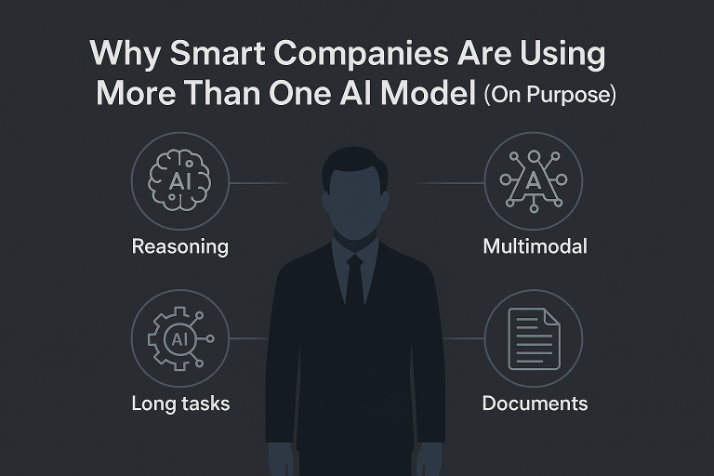

Why Smart Companies Are Using More Than One AI Model (On Purpose)
Most executives ask the same question when they start exploring AI:
“Which model should we pick?”
It feels like the right question.
It’s also the wrong one.
The reality we’re seeing across real deployments is simple: no single AI model is best at everything. And the companies getting the most value from AI have stopped trying to force one model to do every job.
The Myth of the “Best” Model
AI models have strengths and weaknesses—just like people.
Some models are better at:
- Long‑running, multi‑step tasks
- Deep reasoning and decision support
- Processing massive documents accurately
- Handling audio, video, or image inputs
- Responding quickly inside live workflows
When executives try to pick one model to cover all of this, projects stall. Performance suffers. Costs rise. Teams lose trust.
We’ve seen this firsthand.
What Actually Works in the Real World
The companies winning with AI aren’t debating model brands.
They’re designing systems.
In practice, that means:
- One model handles reasoning and decision logic
- Another processes documents or large datasets
- Another supports real‑time interactions or multimodal inputs
- All of them are orchestrated behind the scenes
The user doesn’t see “models.”
They see work getting done.
This is the approach we’ve been using in our own builds—embedding multiple models inside secure, governed workflows rather than exposing teams to raw AI tools or forcing everything through a single engine.
Why This Matters for Executives
AI isn’t software you “install.”
It’s closer to hiring.
You don’t hire one employee to:
- Write code
- Analyze finance data
- Talk to customers
- Review legal documents
- Run operations
So why expect one model to do it all?
Once leaders understand this shift, the conversation changes from:
“Which model should we choose?”
to:
“Which tasks should be automated, and what’s the best tool for each?”
That’s when ROI becomes predictable.
The Hidden Advantage of a Multi‑Model Strategy
There’s another benefit executives don’t always see at first: risk control.
Using multiple models allows organizations to:
- Keep sensitive data routed only to approved systems
- Apply guardrails differently depending on the task
- Swap models as capabilities evolve—without rebuilding everything
- Avoid being locked into a single vendor or roadmap
In other words, it’s not just more powerful.
It’s more resilient.
The CEO Takeaway
Stop searching for the model.
Start building for the job.
The most effective AI strategies look a lot like effective teams:
- Different strengths
- Clear roles
- Strong coordination
- Results that compound over time
That’s how real companies are scaling AI—quietly, deliberately, and on purpose.