
Every Generation Finds Better Leverage. This One Is Ours.
Every generation builds with the tools it has.
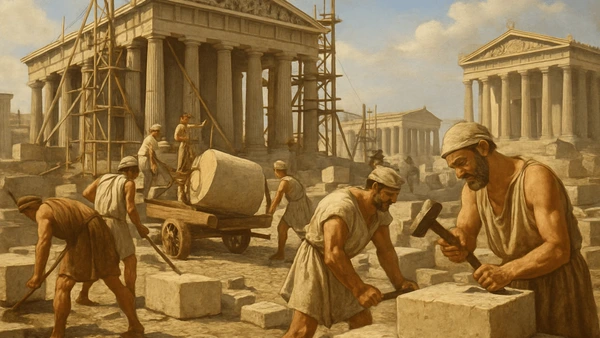
At one point in history, building something meaningful required brute force. Hundreds of people moved stone by hand. Progress was slow, expensive, and physically exhausting, but it worked
- Until we found better leverage.
- We didn’t stop building castles.
- We stopped carrying bricks by hand.
- The invention of the crane didn’t change the goal. It changed how the work got done. The same builders, the same ambition, just amplified.
- Business evolves the same way.
- How We’ve Been Scaling for Decades
For a long time, growth followed a familiar pattern: hire more people to do more work.
- More emails.
- More reports.
- More approvals.
- More follow‑ups.
- More coordination.
This model made sense when businesses were simpler and systems were fewer. When work moved slowly and information lived in one or two places.
But that world is gone.
Today, every decision touches multiple tools. Every workflow crosses teams. Every action creates data that needs to be moved, interpreted, logged, and acted on. Complexity didn’t increase gradually, it compounded.
Most companies didn’t become slow because their people stopped being capable.
They became slow because the volume of manual work quietly outgrew human attention.
The Bottleneck Isn’t Intelligence. It’s Execution.
Inside nearly every modern organization already exists everything needed to scale:
- Massive amounts of data
- Deep domain expertise
- Clearly defined workflows
- Sales processes are mapped.
- Operations are documented.
- Approvals follow rules.
- Reports repeat the same logic every week.
Yet execution is still manual.
Information gets copied and pasted.
Tasks wait in inboxes.
Updates rely on memory instead of systems.
Follow‑ups happen when someone has time.
That’s the bottleneck.
- Not thinking.
- Not strategy.
- But the physical movement of work.
Intelligent Automation Is This Generation’s Leverage
- The real shift isn’t AI as a chatbot.
- It isn’t AI as a novelty.
- It isn’t AI as a demo.
The shift is AI as digital labor.
Intelligent automation means digital workers that operate inside your actual environment, especially where work already happens. Inside Microsoft. Inside your data. Inside your workflows.
These systems don’t brainstorm. They execute.
- They move information between systems.
- They complete routine tasks.
- They trigger actions based on real signals.
- They escalate decisions when human judgment is required.
They run continuously. They don’t forget steps. And they don’t need to be chased.
That’s leverage.
This Isn’t Replacing People. It’s Removing Drag.
New leverage doesn’t eliminate builders. It eliminates unnecessary effort.
What gets automated is the work that never created advantage in the first place, the repetitive, mechanical tasks that drain time and energy without improving outcomes.
What remains is what humans do best: judgment, creativity, leadership, context, and trust.
Why Waiting Quietly Costs You
The cost of staying manual rarely shows up as a single failure. It compounds.
- Hours lost every week.
- Decisions delayed every month.
- Opportunities missed every quarter.
While one company debates AI strategy, another quietly removes friction from daily work by redesigning execution.
The Question That Actually Matters
What are you still doing by hand that should already have leverage?
Where does work slow down for no strategic reason?
Where does information wait on humans instead of flowing automatically?
Where are your best people stuck managing execution instead of making decisions?
Those are your bricks.
And intelligent automation is this generation’s crane.
Every generation finds better leverage.
This one is ours.